
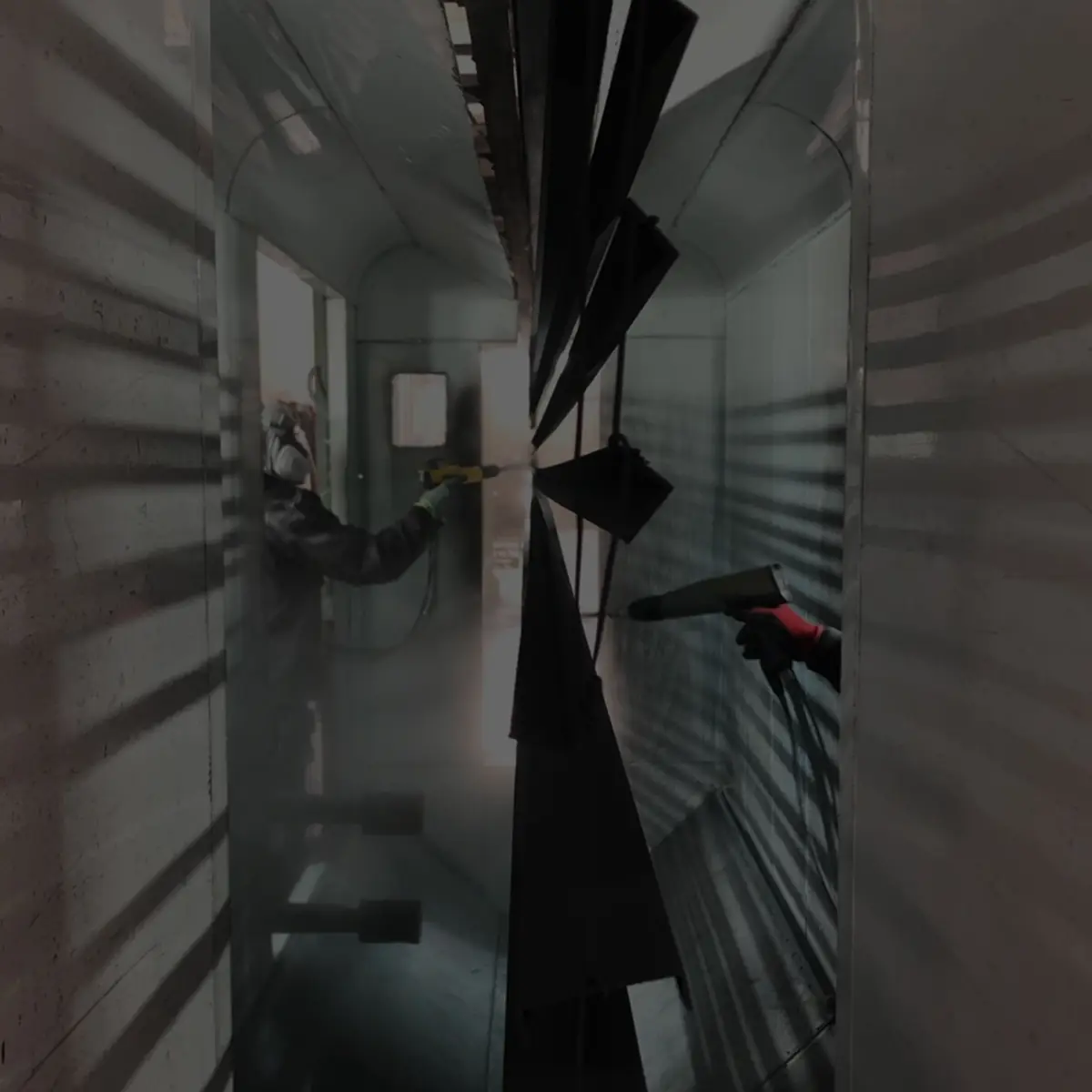
Powder coating of metals
Powder coating of metals covers a series of technological procedures carried out for the high-quality, economical and environmentally friendly coating of metals — most often aluminium and galvanised steel.
Chemical pre-treatment
Degreasing, rinsing and a conversion coating — or a zinc primer for steel that goes outdoors.
Application of powder
Electrostatic application in the booth, by hand for single parts, automatic for batches.
Curing
A 7.5 m oven with a 2.2 × 2.2 m opening — we take parts up to those dimensions.
Quality control
Coating thickness, adhesion and a visual check before dispatch.
What powder coating is
Powder coating is a process in which dry paint in the form of a fine powder is applied electrostatically to a metal surface, then melted in an oven and cross-linked into a hard, continuous film. Unlike wet painting there are no solvents — powder that misses the part is extracted, sieved and returned to the system.
The result is a film that is thicker, harder and more resistant to impact and wear than a normal wet paint, in practically any RAL shade and in several gloss levels.
Four steps
Every job here goes through the same four steps. The first two decide how long the film will last, the third hardens it, the fourth checks it.
What you get
- Protection against corrosion and weather, verified in the salt spray chamber
- An even film with no runs and no brush marks
- Colour to the RAL Classic chart, with texture and different gloss levels available
- A process without solvents — powder that misses the part goes back into the system
Zinc primer instead of galvanising
For steel that goes outdoors we also offer a zinc primer as the base for powder coating. It is a zinc-rich layer applied to the prepared steel before the topcoat, so the zinc protects the base metal and the powder protects the zinc — the same principle as galvanised steel. In many cases it is an adequate substitute for hot-dip or electro-galvanising: the part does not go to a galvaniser and then to us, both layers are done here, in one pass.
Whether it is an adequate substitute for your particular part depends on where it stands and how exposed it is — tell us the use in your enquiry and we will say so plainly.
Limits worth knowing up front
Powder coating is not suitable for every part. The material has to conduct electricity and has to take the curing temperature, so assemblies with plastic, seals or electronics have to be stripped down before treatment.
Over an existing powder coating is fine — a sound old powder layer that is not flaking is a good base. Over liquid (wet) paint is not: that layer has to come off first, because it lets go at curing temperature and the new film has nothing to grip.
Materials
Frequently asked questions
It depends on the quantity, the dimensions and whether extra preparation is needed. For a firm lead time send us the dimensions and the quantity — we reply within one day.
Practically yes. The RAL Classic chart has 213 shades, and alongside them there are textured, metallic and matched-to-sample shades. Shades not held in stock are ordered in, which extends the lead time.
It depends on what they were painted with. Over an existing powder coating, yes — the old powder layer is a good base if it is sound and not flaking. Over liquid (wet) paint, no: that layer has to be stripped first, otherwise the new film has nothing to grip and it will flake off.
Need a quotation?
Tell us the material, dimensions, quantity and RAL shade — we reply within one day.