
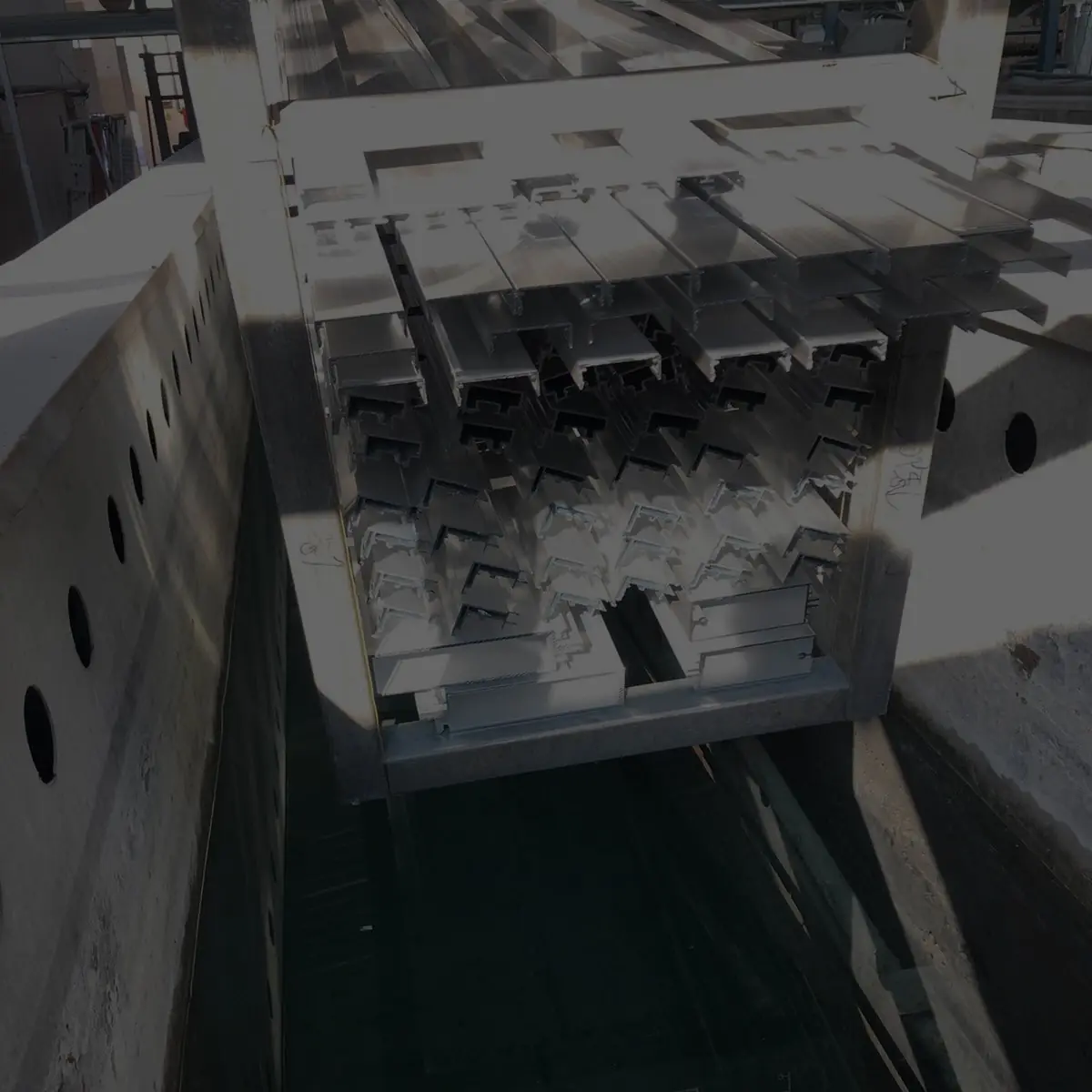
Chemical pre-treatment of metals
High-quality chemical pre-treatment gives great colour durability on the aluminium surface — tested at 1000 h in a salt spray chamber.
Why pre-treatment is the most important step
Powder does not stick to a dirty surface. Grease from machining, fingerprints, the oxide layer and residue from transport — all of it stands between the metal and the coating. If the surface is not properly prepared, the film will look good on delivery and start to flake after the first winter.
That is why the durability of powder coating is measured on the pre-treatment, not on the powder. Our pre-treatment of the aluminium surface is tested at 1000 hours in a salt spray chamber.
Stages of pre-treatment
- Degreasing — removal of oil, grease and machining residue
- Rinsing — removal of degreasing agent residue
- Etching and removal of the oxide layer from aluminium
- Conversion coating — a chemical layer that bonds the metal and the powder
- Final rinse with demineralised water
- Drying before the part enters the booth
The salt spray test
The salt spray chamber is an accelerated corrosion test: the sample stands in a mist of salt water and it is recorded when the first trace of corrosion appears, usually around a scribe cut made deliberately in the film. A result of 1000 hours is the result asked for on aluminium in architectural use.
| Tested | 1000 h in a salt spray chamber |
| Material | Aluminium |
| Final rinse | Demineralised water |
Zinc primer for steel
Mild steel that goes outdoors gets a zinc primer here as the base under the powder: a zinc-rich layer that takes over the role of a galvanised base. In many cases it is an adequate substitute for hot-dip or electro-galvanising, and it is done in the same plant, without sending the part out to be galvanised.
The process
Need a quotation?
Tell us the material, dimensions, quantity and RAL shade — we reply within one day.